El Aprendizaje Que No Se Ve


Why Modern Demand Can’t Be Managed Linearly – A Major Barrier to Scalable Growth!

Modern demand generation is no longer a predictable sequence of steps. Buyers do not move neatly from awareness to consideration to purchase. They explore independently, revisit decisions asynchronously, engage across multiple channels, and often involve several stakeholders before momentum becomes visible. Yet many organizations still operate demand systems designed for a different era.
Campaigns are measured in isolation. Partner ecosystems operate with fragmented visibility. Sales engagement is evaluated through disconnected metrics. And leadership teams are expected to make strategic decisions without a clear picture of how influence is actually forming.
That gap is becoming one of the biggest barriers to scalable growth.
Demand Changed. Most Systems Didn’t.
The challenge is not a lack of activity.
In an effort to capture attention and drive growth, most organizations are producing more campaigns, more content, more enablement materials, and more outreach than ever before. This includes a constant stream of multi-channel marketing campaigns, a deluge of blog posts, videos, and social media updates, comprehensive sales enablement resources, and persistent outreach across email and other platforms.
The issue is that modern demand is non-linear, meaning it doesn’t follow a predictable, straight-line path. Instead, it fluctuates wildly based on trends, viral moments, and sudden shifts in consumer behavior.
Buyers:
- Research independently
- Engage at different times
- Interact across multiple channels
- Consume information asynchronously
- Influence decisions collectively
At the same time, partner ecosystems introduce additional layers of complexity that need to be managed effectively. This includes navigating different business processes, aligning on shared goals, and ensuring seamless integration between technologies and teams.
- Regional execution differences
- Localized messaging
- Shared budgets
- Varying enablement maturity
- Distributed sales engagement
As a system or operation grows in size and complexity, the need for human interpretation and manual decision-making can significantly slow down the entire process, creating a bottleneck that limits efficiency and scalability.
Manually connecting thousands of interactions in real time is an impossible task for any team. The complexity of tracking customer journeys across various partners, geographical regions, different personas, multiple campaigns, and numerous channels requires a level of data synthesis and speed that goes beyond human capability.
Visibility Is the Real Challenge
Many organizations continue to operate with reporting structures that are fundamentally based on a linear, sequential customer journey. This traditional model imagines a straightforward path from awareness to consideration to purchase. However, this no longer reflects reality. In the digital age, influence doesn’t build sequentially in a neat funnel. Instead, it accumulates incrementally across a diverse and scattered array of touchpoints—from social media posts and online reviews to podcast mentions and word-of-mouth recommendations.
That creates critical operational questions:
- Which partners are truly activating?
- Which reps are generating real engagement?
- Which regions show early momentum?
- Where is MDF producing measurable outcomes?
- Which interactions are signals versus noise?
Without granular visibility, governance becomes reactive instead of strategic. And when visibility disappears, accountability often becomes opinion-based.
The Risk of Linear Thinking
Linear systems tend to optimize for distribution:
- More emails
- More assets
- More campaigns
- More reach
But reach alone no longer creates clarity. Modern organizations need systems capable of interpreting demand behavior as it happens. Not just measuring clicks after the fact.
The future of demand management is not simply automation. It is intelligent interpretation.
Why This Matters for Partner Ecosystems
The challenge becomes even more significant in through-channel environments. When vendors, partners, distributors, sales teams, and regional stakeholders all participate in the customer journey, visibility fragments quickly.
Without connected engagement intelligence:
- Partners struggle to prioritize
- Sales teams operate without context
- Marketing loses insight into activation quality
- Leadership cannot identify real momentum early enough
The result is slower execution despite higher activity.
The Shift Toward Demand Sensing
Modern organizations need to move from static reporting toward dynamic demand sensing.
That means:
- Understanding engagement patterns in real time
- Identifying buying momentum earlier
- Connecting interactions across channels and personas
- Interpreting behavior instead of only collecting metrics
Because modern demand is no longer a straight line.
And managing it like one creates blind spots that scale faster than pipeline.
Watch the full podcast episode here: EPISODE HERE
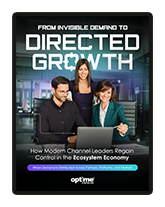
Read the complete ebook: From Invisible Demand to Directed Growth.
Remember to follow Optime on LinkedIn and follow our LinkedIn groups for the latest advances in Rewards, Rebates, MDF, and Partner Demand Automation.